For six months, my 13-year-old son told me he was saving every paycheck from his Saturday job to buy the bicycle he wanted so badly. But the bicycle never appeared, and Evan became increasingly secretive whenever I asked about his money. Then his boss called me, asked one question about his paychecks, and I immediately reached for my car keys.
I discovered that Evan had taken a Saturday job when he came home one evening smelling of cooking oil and lemon soap.
“Where have you been, sweetheart?”
He froze.
“Working.”
“Working? Where?”
“Mr. Alvarez lets me help out at the diner on Saturdays.”
I stared at him in disbelief.
“You got yourself a job without even telling me?”
He lowered his eyes.
“I wanted to earn the money for my bicycle myself, Mom.”
Six months later, he still didn’t have a bicycle.
Every week, I asked him how much he’d managed to save, and every time, he gave me the same answer:
“Almost enough.”
A week earlier, I’d walked past his bedroom and noticed him hurriedly stuffing a stack of banknotes into his backpack the moment he saw me.
Another Saturday, he came home almost two hours late. Dried mud covered his sneakers, and one sleeve of his shirt was torn.
“What happened to you?”
“I fell on my way home.”
“Where’s your paycheck?”
His eyes dropped to the floor.
“Somewhere safe.”
I studied his face.
“Evan, what’s going on?”
“Nothing, Mom.”
I was beginning to wonder what that constant “nothing” really meant when my phone rang one Saturday afternoon.
Mr. Alvarez’s name appeared on the screen.
“Hello?”
“Ma’am? We need to talk about Evan.”
I immediately stood up from the kitchen table.
“Has he done something wrong?”
“Honestly, I don’t even know how to explain this to you…”
“What do you mean?”
He went quiet for a moment.
Then he asked a question I never would have expected:
“Do you know what your son does with every single paycheck?”
“He says he’s saving for a bicycle.”
“Everything that boy has told you is a lie.”
Before I could respond, I heard Evan shouting in the background.
“Please! Don’t tell my mother!”
Something crashed to the floor.
“Evan?” I called out.
Mr. Alvarez came back on the line. He was breathing heavily.
“Ma’am, you need to get here immediately. Your son has tried to do it again.”
Then the call disconnected.
When I rushed into the diner, the first thing I saw was a metal tub lying overturned in the middle of the floor.
Evan was standing right beside it.
His apron was completely soaked. One sleeve of his shirt had twisted around his shoulder, and his cheeks were flushed from an argument.
Facing him was an older man holding a white envelope tightly in both hands.
Evan had grabbed the other end.
“Give it back, Cal!” my son shouted.
“No.”
“That’s my money!”
“Exactly!” Cal snapped. “That’s why I’m not taking it.”
The diner owner, Mr. Alvarez, spotted me standing near the entrance.
“Ma’am… thank goodness!”
Evan suddenly turned around.
The moment he saw me, he let go of the envelope.
“Mom?”
“What’s going on here?”
Nobody answered.
I pointed at the envelope.
“Is that your paycheck?”
Evan stared at the floor.
“Yes.”
“Then why was Cal holding it?”
Cal placed the envelope on the counter.
“Because your son was just trying to give me every last cent of it.”
I looked at Evan.
“What?”
“It’s not like that,” he muttered.
Cal folded his arms.
“Then explain to your mother what it’s really about.”
Evan raised his head.
“Stay out of this!”
“Evan,” I said sharply.
He immediately fell silent.
I picked up the paycheck envelope.
“Evan, why were you trying to give Cal all your money?”
His answer came without hesitation.
“Because I owe him something.”
Cal slapped his palm against the counter.
“There! That’s exactly what he keeps saying!”
“I did owe you something,” Evan argued.
“For what?”
“Because you helped me.”
Cal stared at him in disbelief.
“You helped me carry twelve boxes of potatoes last month. Should I sign over my entire retirement savings to you for that?”
Evan glared at him.
“That’s different.”
“How?”
“Because it just is!”
I turned toward Mr. Alvarez.
“Can somebody please explain what’s happening?”
The owner leaned against the register.
“How much money do you think Evan has saved for his bicycle?”
The question caught me off guard.
“I don’t know. He keeps telling me he’s almost there.”
Mr. Alvarez nodded slowly.
“That’s what he tells us too.”
Evan looked as though someone had slapped him.
“Please stop.”
But Mr. Alvarez ignored him.
“Do you know how many of his paychecks he’s actually kept over the past six months?”
I waited.
“One,” he answered.
For a moment, I thought I’d misheard him.
“One?”
He nodded.
“The first one.”
I turned toward Evan.
“Where did the others go?”
“Mom…”
“Where?”
He didn’t answer.
His silence frightened me more than the broken dishes scattered across the floor.
Evan had wanted a secondhand mountain bike for almost a year. When he first showed it to me, I’d offered to contribute some money.
“No. I want to earn it myself, Mom.”
I’d been incredibly proud of him at the time.
Evan had been ten when we lost Jeremy. Since then, he’d stopped asking me for things.
The diner was a small family-owned business.
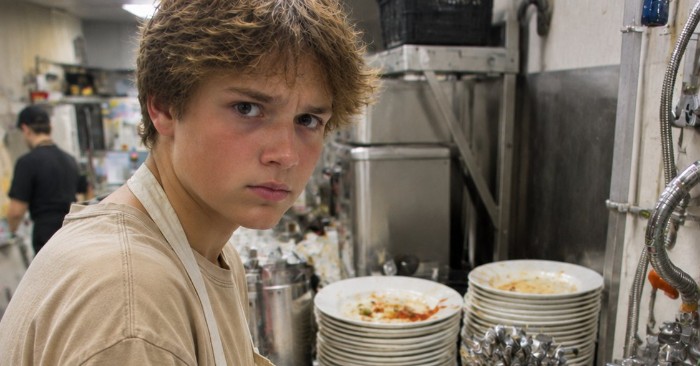
Mr. Alvarez knew us from the neighborhood, and once I found out about Evan’s job, I allowed him to continue working there. His duties were limited to Saturday afternoons: clearing tables, doing light cleaning, and helping out a little in the dishwashing area.
I looked around the diner again.
“Where did all the money go?”
Evan folded his arms.
“It’s my money.”
“Yes, it is. And you’re 13.”
“That doesn’t mean you have to know everything, Mom.”
“No, but when your boss has to call me because you’re trying to hand an adult your entire paycheck and breaking dishes in the process, your privacy becomes a little more limited.”
At that moment, I noticed something beside Evan’s feet.
His backpack had fallen open during the collision with the metal tub.
Several envelopes and a folded city bus map were scattered beside it.
I reached down to pick them up.
Evan was quicker.
“Mom, please don’t…”
That was precisely why I took the map.
He froze completely.
I unfolded it on the nearest table.
Red circles were drawn all over it.
Six of them.
Maybe even seven.
Beside several circles were words written in Evan’s cramped handwriting.
TIRES.
MR. T.
HAIRCUT.
THE SHOP OWNER.
One address had been crossed out three times and written again farther down the street.
Two of the circles had dollar amounts beside them.
$180.
$65.
I looked at Evan.
“What is this?”
“Nothing.”
Mr. Alvarez let out an audible sigh.
“That’s his favorite word.”
I pointed at the circles.
“Have you been taking the bus all over town?”
“Sometimes.”
“All by yourself?”
“I’m not five.”
“You’re 13. And apparently old enough to make a map of people you’re secretly giving money to behind my back.”
“I’m not paying anyone, Mom.”
Cal raised an eyebrow.
“You just tried to give me your paycheck.”
“That was different.”
I tapped the word TIRES.
“What does this mean?”
Evan looked away.
Cal, however, answered immediately.
“The tire shop on Mason Street.”
I turned toward him.
“How do you know that?”
“Because I followed him there last month.”
I stared at him.
“What?”
Cal shrugged.
“He’d already tried to sneak money into my hands twice. Then he kept telling everyone he was saving for a bicycle. I wanted to know where the rest of it was going.”
“You followed me?” Evan practically exploded.
“I walked three streets behind you.”
“That’s called following someone!”
“Whatever!” Cal sighed. “Eventually, I got tired and took the bus back.”
The tire shop on Mason Street.
I knew that place.
I hadn’t been there in years.
Not since the winter after Jeremy died.
I folded the map.
“Get your backpack.”
Evan’s eyes widened.
“Why?”
“We’re going to the tire shop.”
“No.”
“Evan.”
“Mom, please.”
That “please” sounded different.
Not defiant.
Frightened.
“What am I going to find there?” I asked firmly.
Evan swallowed and stared out the diner’s window.
“Nothing.”
Cal shook his head.
“There it is again.”
I handed Mr. Alvarez the paycheck envelope.
“Could you please hold on to this until we get back?”
“I’ve been trying to get him to keep his own money this entire time.”
Evan grabbed his backpack.
“I hate all of you!”
Cal pointed after him.
“That’s perfectly normal 13-year-old behavior. At least keep that!”
Evan sat stiffly beside me during the drive to the tire shop.
I remembered that place all too well.
Jeremy had been gone for four months.
Our old car had gotten a flat tire on a freezing February afternoon.
I drove to the shop on Mason Street, hoping they could simply repair it.
Twenty minutes later, the owner came outside and explained that another tire was almost completely worn out too.
I only had enough money for one.
I still remember standing beside the counter while Evan, who was only ten at the time, drank a hot chocolate someone had given him.
I asked the owner if we could wait another two weeks before replacing the second tire.
He looked at me.
Then he glanced at Evan.
And finally, he simply replaced both tires.
When I explained that I couldn’t afford to pay for the second one, he pushed the invoice back toward me.
“Then don’t pay today.”
Afterward, I sat in my car and cried.
I hadn’t thought about that afternoon in years.
Not until I saw the word TIRES on my son’s map.
When we walked into the shop, the same owner was standing behind the counter.
He was older now.
His hair had turned considerably grayer.
He looked up.
His eyes landed on Evan.
“Oh, no.”
Evan froze.
The man pointed at him.
“You promised me you’d stop doing this.”
I looked between them.
“Stop doing what?”
As soon as the owner recognized my face, a broad smile spread across his features.
“Lindsay?”
“Yes.”
He looked back at Evan and briefly closed his eyes.
“Oh, son…”
Evan immediately started talking.
“I told you not to tell her!”
“I didn’t.”
“You’re doing it right now!”
The man came out from behind the counter.
“Lindsay, a few months ago, your son showed up here with $180.”
I looked at Evan.
The owner continued:
“He claimed he still owed me money for a tire.”
I stared at him.
“For that tire from all those years ago?”
“Exactly that one.”
“You accepted money from a 13-year-old?”
His face turned red.
“Not immediately.”
Evan muttered:
“He argued with me for about twenty minutes.”
“Because I was about to call your mother!”
“You said I was bothering your customers.”
“Well, you were!”
I raised my hand.
“Can someone please explain what happened?”
The owner sighed.
“He simply refused to leave. Eventually, I accepted the envelope because I was trying to figure out how I could return the money to you later.”
He opened a drawer beneath the register.
Then he placed a worn white envelope on the counter.
Two words were written across the front in Evan’s handwriting:
FOR THE TIRES.
I looked at my son.
“You really saved that money?”
The owner nodded.
“Every single dollar.”
Evan reached for it.
I caught him by the wrist.
“No.”
His eyes flashed angrily.
“That’s not your money, Mom.”
“Actually, sweetheart, that particular debt belonged to me long before you were even old enough to shave.”
The owner almost smiled.
Evan didn’t.
He pulled his hand away.
“We needed those tires back then.”
“I know.”
“So we owed him.”
“No,” I corrected him. “I owed him.”
Evan looked at me in complete confusion.
I studied the envelope again. For the first time, I stopped wondering what my son had bought with his money. Instead, I began wondering who he believed he owed.
I unfolded the bus map again.
The tire shop.
The barber.
The grocery store.
A street near Evan’s old elementary school.
People.
Places.
Amounts of money.
I looked at him.
“How do you even remember all of this?”
Evan said four words that suddenly made every circle on that map look completely different.
“Dad would have remembered.”
I froze.
The shop owner looked away.
I lowered the map.
“What does your father have to do with this?”
Evan reached for his backpack.
“Nothing.”
This time, I didn’t let him simply walk away.
I stepped in front of the door.
“Evan.”
“Move, Mom.”
“No.”
His eyes filled with tears. That frightened me more than his anger.
“Please, Mom.”
“Tell me.”
“I can’t.”
“Why not?”
He roughly wiped his face with his sleeve.
Then he looked at the map in my hand.
At all the red circles.
At all the places that reminded me of the worst year of our lives.
Finally, he whispered:
“Because you’ll tell me to stop.”
As I looked at the circles again, something suddenly became clear.
Whatever my son had been doing every Saturday, it had never really been about buying a bicycle.
And somehow, it had all started with his father.
I stared at him.
“Stop doing what?”
Evan looked down at the floor.
“Because Dad can’t do it anymore.”
I couldn’t move.
He wiped his face again with his sleeve.
“Everyone helped us after he died. With the tires, the food, the rides, the haircuts.”
He looked at the map.
“Dad always said you should give something back to people.”
I thought about the Saturday he’d come home covered in dirt.
“Where were you that evening when you got home so late?”
Evan rubbed his sneaker against the pavement.
“At Mrs. Donnelly’s.”
I immediately recognized the name.
She had lived two streets away when Jeremy died. For months, she’d picked Evan up from school whenever I couldn’t get away from work.
“What happened to your shirt?”
“Her garden fence had fallen over. I helped her put it back up.”
That answer left me speechless.
So I drove him to Jeremy’s favorite park.
We sat beside the bike path. His crumpled bus map lay between us.
After a while, I said:
“Your father borrowed Mrs. Donnelly’s ladder for eleven years.”
Evan looked at me.
“What?”
“Eleven years.”
“That can’t be true.”
“It is. And once, he borrowed money from Mr. Alvarez and forgot to pay it back for six months. Your father helped people, Evan. But other people helped him too.”
Evan stared at the circles on his map.
“But Dad can’t do his part anymore.”
I moved closer to him.
“You inherited your father’s love for helping people. But you didn’t inherit his unfinished obligations.”
Suddenly, he burst into tears and leaned against my shoulder.
“I thought you needed me, Mom.”
“I need my son,” I told him. “I don’t need another adult who feels responsible for taking care of everything.”
Later, we drove back to the diner together.
Cal pointed at Evan’s paycheck envelope.
“If you try to give that to me one more time, I’m retiring twice.”
Evan almost smiled.
Then he slowly slipped the envelope into his own pocket.
A few months later, he finally bought the secondhand bicycle.
One day at the park, he stopped to help a younger boy fix a chain that had slipped off his bike.
“How much do I owe you?” the boy’s father asked.
Evan hesitated briefly.
“Just help someone else when they get stuck.”
Then he climbed back onto his bicycle.
“Mom! Time me!”
I unfolded the old bus map.
On the back, Evan had drawn the bike path and written underneath:
PERSONAL BEST: 38 SECONDS.
I raised my phone.
“Go!”
And my son kept riding.