For years, my granddaughter Lily was always the first to rush into Grandpa Jim’s arms as soon as she stepped through the door. But when she came to stay with us one week and suddenly refused to hug him goodnight, I assumed it was just exhaustion. Later that night, though, as I tucked her into bed, she whispered softly, “Grandma… he’s different.”
Lily had always adored Jim, as if he were the most important person in her world. The moment she arrived, she would run to him, her arms wide open, calling out, “I’m here!” as if she had just returned from an important mission.
Jim was her “favorite person.” He taught her to ride a bike, shuffle cards, whistle through her fingers, and let her wear his old baseball cap around the house like a crown. Even though he pretended not to enjoy her affection, it was clear to everyone that he treasured those moments more than anything.
One Monday morning last month, my daughter Erin called me, her voice tense and fatigued.
“Mom, can Lily stay with you for a week?” she asked, her voice tight. “It’s a bit complicated with work.”
“Of course, bring her tonight.”
The first three days felt like normal.
Lily rushed out of the car and up our driveway, yelling, “GRANDPA!” Jim opened his arms, and she barreled into him with such force that he let out a surprised grunt.
“Easy there, kiddo,” he laughed. “You’re getting stronger!”
“I’m seven,” Lily said matter-of-factly, as if that explained everything.
The days passed in their usual rhythm: pancakes in the morning, board games in the afternoon, and Jim letting Lily win while she pretended not to notice.
But by the fourth day, something had changed.
Lily became quieter. When Jim walked into a room, she followed him, standing by the counter while he made coffee and narrating every move.
“First you scoop,” she said seriously. “Then you pour. Then you wait. And then you don’t drink it because it’s yucky.”
Jim chuckled. “See? I’m raising a critic.”
That night, things were off. At dinner, Lily pushed peas around her plate and answered Jim’s questions with short, distant replies.
“Hey, Lil. Want to play cards after dinner?” Jim asked.
“Maybe later,” she answered flatly.
Later, after she brushed her teeth, Jim stood by the couch, waiting for their usual goodnight hug.
I smiled. “Go give Grandpa a hug before bed.”
Lily stopped in the hallway and stared at him for a moment, then shook her head.
Jim’s smile faltered, but he tried to maintain it. “No hug tonight?”
“I’m sleepy,” she said softly.
And then, in a near whisper, Lily added, “Grandma… he’s different.”
Jim stood still for a moment, before nodding. “Okay, sleep tight,” he said, though his voice seemed uncertain.
Lily walked into the guest room and shut the door. Later, when I tucked her in, she stared up at the ceiling, deep in thought.
“Sweetheart, why didn’t you hug Grandpa? You always do,” I asked gently.
She hesitated, choosing her words carefully. “Grandma… he’s different.”
“Different how?” My heart started to race.
Lily swallowed hard before whispering, “He was crying.”
My chest tightened. “Grandpa was crying?”
She nodded, her eyes welling with tears. “Last night. I got up for water. I heard noises.”
I sat beside her, trying to steady my breathing. “What kind of noises?”
“Like… when someone tries not to be loud. I peeked in the kitchen.”
I froze, a cold shiver running through me.
“Grandpa was at the table,” Lily continued. “His head was down. He was shaking. He had his hands on his face. Grandpa never cries. He looked… small.”
My heart shattered. “Thank you for telling me, sweetheart. You did the right thing.”
Her voice quivered. “Is he mad at me?”
“No, sweetheart. Never. You didn’t make him cry. Sometimes grown-ups cry. Even the strong ones. It doesn’t mean you’re unsafe.”
“But he’s different,” Lily whispered, her words sinking deep.
“I know, sweetheart. I’m going to talk to him. Okay?”
She nodded, her little face full of worry. “Okay.”
After I left her room, I stood in the hallway, listening. The house felt unnervingly empty. I found Jim sitting in his recliner, his book open but his eyes distant. When I asked if he was okay, he answered with a flat “fine,” but his tone lacked conviction.
The next morning, I noticed more signs that something was wrong. He laughed, but it sounded forced. “Guess it’s boring,” he said.
That night, I could hardly sleep. I kept seeing the image of him at the kitchen table, alone, struggling to suppress his sobs.
In the morning, I found him acting strangely again. He reached for the sugar, then stopped, staring blankly at the counter.
“It’s right there,” I said gently.
“Right. Of course,” he muttered, almost as if he didn’t recognize where he was.
Later, Lily asked him to show her a card trick. He shuffled the deck but then paused mid-motion, clearly frustrated with himself.
That afternoon, I found him at his desk, papers scattered across it. When he saw me, he quickly shoved them into a drawer.
“Since when do you hide bills?” I asked, a knot of concern forming in my stomach.
He didn’t respond, just slammed the drawer shut.
That night, after Lily went to bed, I sat down beside him. “We need to talk,” I said gently.
“She shouldn’t have been up,” he muttered, avoiding my gaze.
“Jim,” I pressed softly, “Lily saw you crying.”
His face went blank. “She shouldn’t have been up.”
“Tell me what’s really going on.”
“I was tired. I had a moment,” he said, but his voice didn’t match the words.
“A moment doesn’t make a child stop hugging you, Jim. She thinks something’s wrong.”
“Kids are dramatic,” he dismissed, but I didn’t let it go.
“Don’t dismiss her. Tell me the truth.”
He shook his head, his frustration evident. “Nothing.”
I opened the drawer.
Inside, I found an appointment card, a pamphlet, and a printout labeled: “Neurology. Cognitive Assessment. Follow-up.”
A cold wave of realization hit me.
“Jim,” I whispered, “what’s going on?”
He stood in the doorway, his face pale and tired. When he saw the papers, he froze. “You went through my things,” he said softly.
“I had to. Because you wouldn’t tell me.”
For a moment, he was angry, but then his shoulders slumped. “They said it’s early,” he murmured. “They love that word.”
“Why didn’t you tell me?”
He let out a bitter laugh. “Because then it’s real.”
“What did they say?”
“They said it’s early,” he repeated. “I’ve been forgetting things. Names. Why I walked into a room. They think it’s Alzheimer’s.”
The room seemed to spin.
“Oh, Jim,” I whispered, tears welling up. “I’m so sorry.”
He pressed his palms to his face. “I can’t stop it. I feel it happening.”
“Why didn’t you tell me?”
His voice cracked. “I didn’t want to be a burden.”
“You’re not a burden,” I said firmly. “You’re my husband.”
“And Lily,” he whispered. “She looks at me like I’m the safest place. I didn’t want that to change.”
I felt my heart break for him. “So you cried alone.”
He flinched. “I thought everyone was asleep.”
“Lily saw you,” I said softly. “Now she’s confused.”
Jim’s eyes filled with tears. “I never meant—”
“I know,” I said gently. “But we can’t hide this anymore.”
He nodded slowly. “You’re right.”
“I’m calling Erin,” I said. “Today.”
The next day, Jim told Erin and Daniel about the diagnosis. He didn’t hide it anymore. Erin held him tightly, tears in her eyes, and Daniel remained silent, his face tense.
“No more secrets,” I said firmly. “No more hiding things from the kids.”
Erin hugged Jim again. “Why didn’t you tell me?”
“I didn’t want to worry you.”
“We’re going to worry,” Erin said, her voice thick with emotion. “That’s love.”
“Lily saw him crying. That’s why she stopped hugging him,” I said quietly.
Erin’s face crumpled. “Oh, Mom.”
Jim whispered, “I’m sorry.”
“I’m not sorry,” I said firmly. “I’m glad we’re facing this now. No more secrets.”
We made a plan for Jim’s treatment and appointments. Erin offered rides, Daniel would handle insurance calls, and I asked Erin to talk to Lily’s teacher to ensure school remained a steady place for her.
That night, I sat on Lily’s bed. “Sweetheart, can we talk about Grandpa?”
Lily’s eyes widened. “Is he okay?”
“He’s going through something hard,” I explained gently. “Sometimes his brain gets mixed up. That makes him sad.”
Lily’s face softened. “So he cried?”
“Yes. And it’s okay,” I said, holding her hand.
“Is he still Grandpa?” she asked.
“Yes. He’s still Grandpa. He just might need more help sometimes.”
Lily nodded. “Okay.”
We walked into the living room. Jim looked up, as if he had been holding his breath all day.
“Hi, kiddo,” he said, his voice shaking.
Lily stood a few feet away. “You’re still my favorite,” she said softly.
Then she added, “Grandpa, you were crying.”
Jim nodded, tears filling his eyes. “I was. I’m sorry you saw that.”
“Are you mad?”
“Never,” he whispered. “I was sad. But I’m still me.”
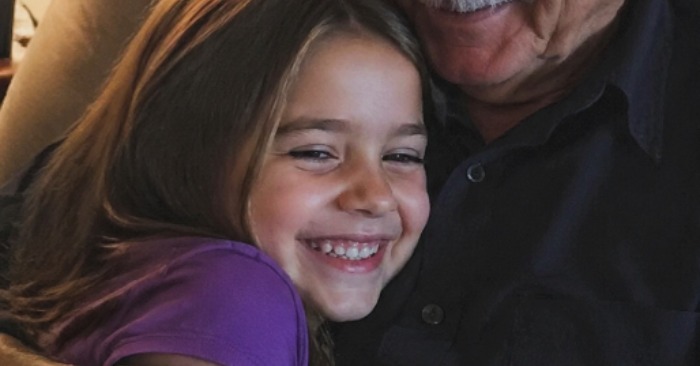
Lily stepped forward and hugged him tight. “You’re still my favorite.”
Jim made a soft, broken sound and knelt down, pulling her into his arms. “I’m lucky, then.”
Lily pulled back, her voice serious. “No more secrets.”
Jim glanced at me, eyes wet. “No more secrets,” he promised.
Later that night, after Lily went to bed, Jim and I sat in the kitchen, the silence heavy.
“I thought if I pretended it was small, it would stay small,” he said quietly.
“We don’t get to pretend,” I replied softly. “We face it together.”
The next day, Erin picked up Lily, and she hugged Jim before she left. She put on his old baseball cap without a joke, her expression serious, as if it truly mattered.
“See you soon,” she said, her voice steady.
As Erin drove off, I drove to the cemetery, unsure of why I needed to go there. I just needed a place where I could let the fear wash over me, a place where I didn’t have to be strong.
The wind was sharp, the sky too bright, but I let myself sit there, feeling the full weight of the fear. Then, slowly, I stood and walked back to the car, knowing that Jim needed me and I wanted to be there for him.
When I returned home, Jim was in the kitchen with his book. He looked up as I entered.
“You okay?” he asked quietly.
“No,” I admitted. “But I will be.”
He gave me a small, tired smile. “Me too.”
I walked over to him and wrapped my arms around him. He held me back, solid and warm.
For now, he was still here.