He picked it up and unfolded it.
The message was short. Just one line.
“For the nights you pretended everything was fine.”
The words landed quietly, but they changed the atmosphere at the table instantly.
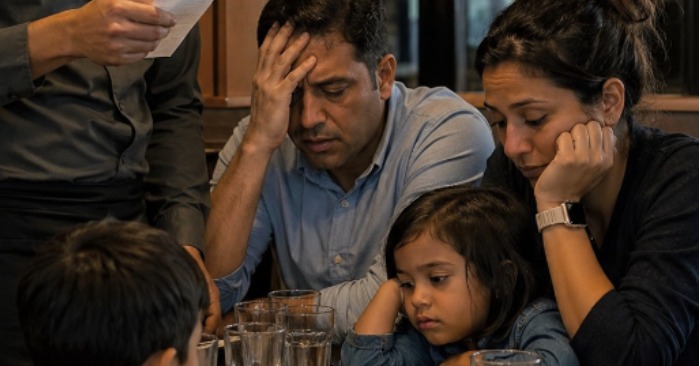
The mother lowered her gaze, her fingers tightening slightly around her glass. She didn’t speak. She didn’t need to. Something in her expression shifted — not shock, not surprise, but recognition.
“He heard us…” she whispered after a moment.
It wasn’t hard to understand what she meant. Their conversation earlier — low, careful, but not silent — had carried more than they realized. The small reassurances, the forced calm, the way they spoke to their children like everything was stable, even when it clearly wasn’t.
Someone had noticed.
Not just their presence. Their effort.
The father exhaled slowly, his shoulders dropping just a little. He looked at the note again, then folded it carefully, as if it mattered more than the meal itself.
There was no dramatic reaction. No tears, no loud gratitude. Just a quiet shift in how they sat, how they looked at each other.
For a moment, they weren’t pretending.
The youngest child broke the silence with a soft question. “Are we okay?”
The father looked at him, then at his wife, then back again.
This time, when he answered, his voice was calmer. Not forced. Not rehearsed.
“Yeah,” he said. “We are.”
And for the first time that evening, it sounded like something he actually believed.
PART 2: Tucked just beneath the edge of the plate was a small folded piece of paper. It blended in so easily it could have been missed entirely