I read the sentence again.
He knows I survived.
My hands started shaking so badly that the photograph slipped onto the floor.
Grandma bent to pick it up.
For several seconds, neither of us spoke.
Finally she whispered:
“Emma… your father died.”
“I know.”
“You saw the coffin.”
“No.”
The word came out before I even realised what I was saying.
Grandma looked at me.
I remembered that week as if it belonged to another lifetime.
People filling our house.
Food arriving from neighbours.
Police officers in dress uniforms.
Flags.
Flowers.
Glen staying beside me almost constantly.
But I had never actually seen Dad after that night.
The funeral had been closed casket.
Glen had explained that Dad’s injuries were too severe.
At thirteen, I hadn’t questioned it.
Why would I?
Glen had been Dad’s closest friend.
He had eaten at our kitchen table.
He remembered my birthdays.
He taught me how to ride a bicycle after Dad hurt his shoulder.
After the funeral, he checked on Grandma and me for years.
I trusted him almost as much as I had trusted my father.
Now Dad’s letter was telling me not to.
Grandma unfolded the remaining pages.
“Read everything.”
So I did.
Dad had written the letter several weeks before the night he disappeared.
He said he had discovered something troubling inside his department.
Evidence from several cases had been going missing.
Reports were being altered after officers submitted them.
Money seized during investigations was sometimes recorded incorrectly.
At first Dad thought it was sloppy paperwork.
Then he noticed the same names appearing again and again.
One belonged to a senior officer.
Another belonged to a local businessman.
And the third was Glen.
My chest hurt.
“No.”
Grandma looked at me.
“He could have been investigating Glen.”
I shook my head.
“Glen loved him.”
“People can love someone and still hide things from them.”
I continued reading.
Dad wrote that he had confronted Glen privately.
But Glen had reacted in a way Dad hadn’t expected.
He told Dad he was making a dangerous mistake.
Then he begged him to stop asking questions.
The letter became harder to follow after that.
Dad clearly feared someone was watching him.
He wrote that he had copied several documents and hidden them somewhere safe.
But then came the strangest sentence.
“If Glen tells you I died that night, remember that he may be saying it because I asked him to.”
I stared at the page.
Grandma stared too.
“That changes everything,” she whispered.
Maybe Glen had not betrayed Dad.
Maybe Dad had planned his own disappearance.
But why?
And where had he gone?
The third man in the photograph suddenly mattered more than anything.
Grandma turned it over again.
I studied his face.
Grey hair.
Heavy eyebrows.
A small scar near his jaw.
“I really did see him at the funeral,” Grandma said.
“Who was he?”
“I thought he was another officer.”
There was a knock at the front door.
Both of us froze.
Another knock.
Then Glen’s voice.
“Emma? Your grandmother told me you were working on the dress tonight. I brought something for you.”
My heart nearly stopped.
Grandma whispered:
“Don’t tell him about the letter.”
We quickly pushed the envelope and photograph beneath a pile of fabric.
Then Grandma opened the door.
Glen entered carrying a small garment box.
He was older now, his hair almost completely grey.
He smiled when he saw the pieces of Dad’s uniform spread across the table.
For one moment, his expression softened.
“He would’ve loved this.”
I watched his face.
Five years of memories suddenly felt suspicious.
Every birthday call.
Every visit.
Every time he asked whether we needed anything.
Had he been protecting us?
Or watching us?
Then his eyes moved toward the jacket.
He stopped.
The colour drained from his face.
“You cut the lining?”
I said nothing.
Glen looked at Grandma.
Then at me.
“What did you find?”
That was the moment I knew.
He already knew something had been hidden there.
I stepped backward.
“What was in Dad’s jacket, Glen?”
He slowly placed the box on the table.
“Emma—”
“Was my father alive after you told me he died?”
Glen closed his eyes.
Grandma gasped.
I could barely breathe.
“Answer me.”
“Yes.”
The room went silent.
I slapped him.
The sound cracked through the kitchen.
Grandma grabbed my arm, but Glen didn’t move.
He simply stood there.
“You let me bury him.”
“There was no body in that coffin.”
“You stood beside me while I cried!”
“I know.”
“You told me he died!”
“I know.”
“WHY?”
Glen finally looked at me.
“Because someone tried to kill him.”
Everything stopped.
He explained that Dad’s investigation had gone much deeper than the missing evidence.
Someone inside the department had been protecting a criminal network for years.
Dad had gathered enough information to expose it.
But before he could turn everything over to outside investigators, someone learned what he was doing.
The night Dad supposedly died, his patrol car was deliberately forced off an isolated road.
Glen reached him before anyone else.
Dad was injured.
But alive.
And terrified.
Because the only people who knew his route that night were police officers.
He no longer knew whom to trust.
“So you made him disappear?”
Glen nodded.
“We had minutes.”
The ambulance report had been falsified.
A closed coffin had been arranged.
Outside investigators quietly moved Dad into witness protection while they built a larger case.
I felt sick.
“Five years?”
Glen’s face tightened.
“It wasn’t supposed to be five years.”
“Then where is he?”
Glen looked toward the table.
“I don’t know.”
I laughed bitterly.
“You expect me to believe that?”
“The last time I spoke to him was three years ago.”
Grandma sat down heavily.
“What happened?”
The investigation collapsed.
A key witness vanished.
Evidence disappeared.
Several suspects were never charged.
Dad became convinced that returning home would put me in danger.
So he stayed away.
I could barely process it.
“He abandoned me.”
“No,” Glen said. “He thought staying away was protecting you.”
“That’s still leaving.”
Glen had no answer.
Then I remembered the third man in the photograph.
I pulled it from beneath the fabric.
“Who is he?”
Glen’s expression changed instantly.
“That’s Thomas Vane.”
“The man from the funeral?”
“Yes.”
“Why was he there?”
Glen stared at the photograph.
“He shouldn’t have been.”
He grabbed his phone.
“What are you doing?”
“Calling someone I should’ve called years ago.”
But before he could dial, Grandma pointed toward the photograph.
“Wait.”
She had noticed something.
Behind the three men was a building.
A tiny rural railway station.
And beside it, barely visible, was a sign.
Grandma recognised the place.
“My sister lived near there.”
She looked at me.
“That station closed years ago.”
Glen leaned closer.
Then he understood.
Dad had not included the photograph merely as evidence.
It was a clue.
We drove there the next morning.
The old station stood abandoned beneath weeds and broken boards.
Behind it was a row of storage sheds.
Inside the third shed, beneath a loose plank, Glen found a sealed metal container.
Documents were inside.
Photographs.
Copies of reports.
A flash drive.
And another envelope.
This one was dated only six months earlier.
My name was on it.
I opened it immediately.
Dad’s handwriting had changed.
It looked shakier.
Older.
But it was unmistakably his.
He wrote that he had spent years trying to find a safe way home.
He apologised for every birthday he missed.
Every Christmas.
Every ordinary morning when I had needed him.
Then came the sentence that destroyed me.
“I told myself I was protecting you, Emma. Eventually I realised I was also hiding because I was afraid you would hate me for leaving.”
I sat on the dusty floor and cried.
Not because he was dead.
Because maybe he wasn’t.
And because if he was still alive, he had chosen silence for years.
The flash drive changed everything.
The evidence was enough to reopen the old investigation.
Thomas Vane, the man in the photograph, had been involved in covering up evidence and intimidating witnesses.
He had attended Dad’s funeral to make certain the story was real.
But there was still one question.
Where was Dad?
Three weeks passed.
Prom arrived.
I almost didn’t go.
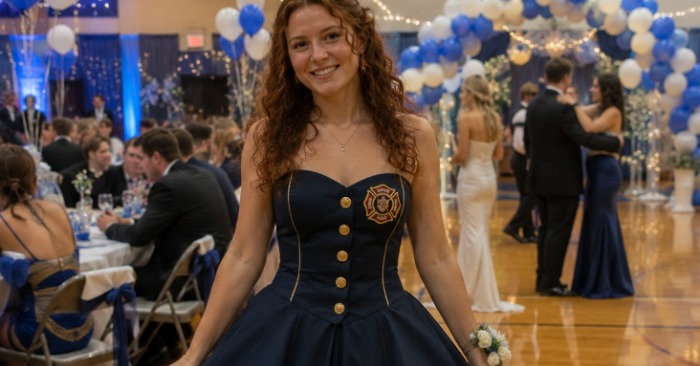
Then Grandma finished the dress.
Dark navy fabric from Dad’s uniform formed the bodice.
His original brass buttons ran along one side.
Inside the skirt, Grandma carefully stitched a tiny piece of the old jacket lining.
Not the part containing the letter.
Another piece.
Something ordinary.
Something that had once rested near him.
“You should wear it,” she said.
“For him?”
Grandma shook her head.
“For yourself.”
So I did.
I walked into prom carrying anger, love, grief and hope all at once.
Halfway through the evening, Glen appeared at the entrance.
He wasn’t smiling.
He simply held out his phone.
“There’s someone who wants to speak to you.”
I stared at him.
My hands started shaking.
“Who?”
Glen didn’t answer.
He pressed the phone into my palm.
I lifted it to my ear.
For several seconds, all I heard was breathing.
Then a man’s voice said:
“Emma?”
My knees nearly gave out.
I knew that voice.
Older.
Rougher.
But I knew it.
“Dad?”
Silence.
Then:
“I’m sorry.”
I walked out of the ballroom before anyone could see me collapse.
I sat on the pavement in my prom dress and cried harder than I had cried at his funeral.
He was alive.
Living under another name several states away.
The renewed investigation finally made it possible for him to contact me safely.
But when we met two weeks later, there was no perfect reunion.
I didn’t run into his arms.
I stood several feet away.
He looked older than the father in my memories.
Smaller somehow.
Human.
“You missed everything,” I told him.
“I know.”
“My birthdays.”
“I know.”
“Graduation preparations. Grandma getting sick last winter. Everything.”
His eyes filled.
“I know.”
“You could have found a way.”
“I should have.”
That answer mattered.
He didn’t defend himself.
He didn’t call every decision noble.
He admitted that fear had slowly become an excuse.
Then he noticed my prom dress hanging inside the garment bag beside me.
“Is that…”
“Your uniform.”
He covered his mouth.
For the first time, I saw my father cry.
I wasn’t ready to forgive him completely.
Maybe I never would be.
But I let him sit beside me.
And for the first time in five years, I didn’t have to remember what my father’s voice sounded like.
I could hear it.
The dress had begun as a way to carry someone I believed I had lost.
Instead, hidden inside its fabric was the truth that brought him back.
Not as the perfect hero I remembered.
But as something more difficult.
A father who had made terrible choices while trying to do the right thing.
And a daughter finally old enough to decide for herself what forgiveness would mean.