I was eighteen when I went to prom with the only family I truly had left—my grandmother.
My mother died the day I was born. My father was never part of my life. So when people talked about “home” or “family,” I always thought of one person only: Marta.
She raised me alone. By the time I was born, she was already in her fifties. Her hands were rough from work, her body often tired and aching, but she never once allowed herself to complain in front of me.
At night, she would sit beside my bed and read stories even when her eyelids kept closing from exhaustion. On weekends, she made simple pancakes just so I could feel like I had something special, even when money barely stretched to cover essentials. She never missed a school event—always sitting quietly in the back, clapping like I was the only student in the room.
To support us, she worked as a cleaner. And not just anywhere—she cleaned the very school I attended.
That’s when the cruelty started.
Some students joked that I would “end up mopping floors too.” Others laughed when they saw her in the hallways with her cart. Whispers followed me everywhere, sharp and careless.
I noticed everything. Every smirk. Every glance. Every joke said just loud enough to hurt.
But I never told her. She already carried enough. She worked so hard so I could have a normal life, and I couldn’t bring myself to add shame to her burden.
And then came prom night.
Everyone was talking about dates, dresses, parties, future memories they wanted to create. I already knew mine.
When I asked my grandmother to come with me, she laughed at first, thinking I was joking. Then she refused, saying she didn’t belong in a place like that. But in the end, she agreed.
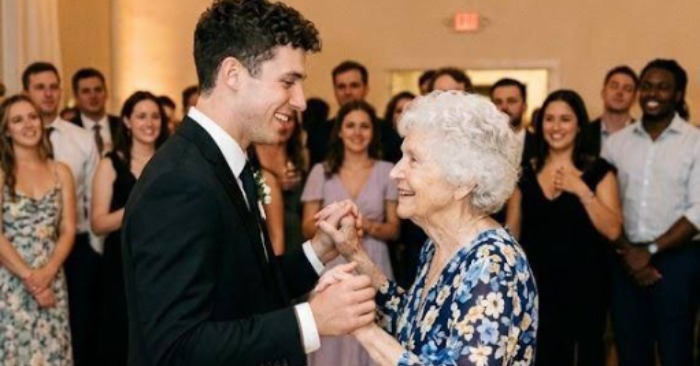
She wore an old floral dress she had kept for years. Before we left, she kept adjusting it nervously, apologizing for not looking “proper enough.” To me, she looked like the most important person in the room before we even arrived.
At prom, the music was loud, the lights bright, the energy chaotic. People were laughing, dancing, choosing partners.
Then I walked straight to her.
I held out my hand.
“Dance with me,” I said.
She hesitated—but she took it.
And the room reacted immediately.
Laughter spread like a wave.
Someone called out, mocking us loudly. Another voice followed, laughing even harder. The words stung, careless and cruel.
My grandmother’s hand trembled. She tried to smile, but I could see it breaking inside her. She whispered that maybe we should leave, that she didn’t want to embarrass me.
That was the moment everything inside me snapped.
I released her hand, walked to the stage, and asked for the music to stop.
The room slowly fell silent.
I took the microphone.
“Right now,” I said, my voice steady, “you’re laughing at the woman who has cleaned this school for twenty years.”
No one moved.
“She made sure I had food when things were hard. She bought my school supplies instead of buying anything for herself. She came home exhausted every night and still sat beside me to make sure I didn’t feel alone.”
I looked back at her.
“Because of her, I finished this school. Because of her, I earned a scholarship and a future.”
My grip tightened on the mic.
“So if you ever meet someone who sacrifices even a fraction of what she did for me… don’t laugh at them. Thank them.”
The silence that followed was heavy, almost unbearable.
Then a teacher started clapping.
Then another.
And within seconds, the entire hall followed—until the sound of applause filled the room completely.