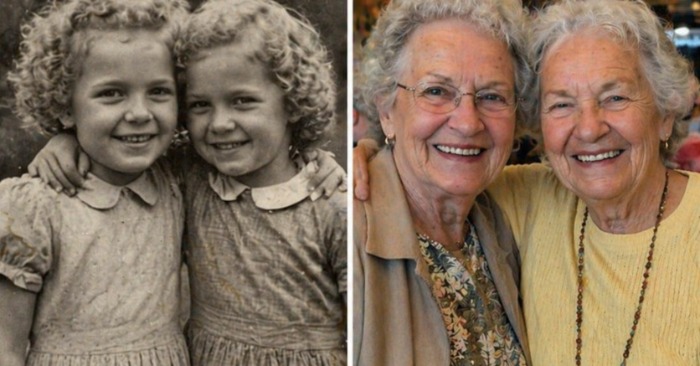
At five years old, my twin sister, Ella, disappeared into the woods behind our house and was never seen again. The police said they found her body, but I never saw a grave or attended a funeral. What followed was a lifetime of unanswered questions, and a hole in my heart where she should have been.
Now, at 73, I, Dorothy, still feel the absence of that missing piece—shaped like my little sister, Ella.
Ella and I were inseparable, two halves of a whole. We shared everything—our birthday, our toys, our bed, our laughter. If one of us cried, the other followed suit. If one of us laughed, it echoed louder. She was the bold one, the one with all the ideas, and I, the quieter twin, was happy to follow.
That day—the day she vanished—is still seared into my memory. Our parents were at work, and we were staying at Grandma’s house. I had a fever, and Grandma was sitting beside me, gently pressing a cool washcloth to my forehead.
“Rest, sweetheart. Ella will play quietly,” she murmured.
I could hear the soft thud of Ella’s red ball bouncing against the wall as she hummed, filling the room with a melody that seemed to belong only to her. I closed my eyes, drifting in and out of sleep, the sound of rain beginning to tap against the window.
When I woke up, something was terribly wrong.
The house was eerily quiet.
No ball. No humming.
I called out, “Grandma?”
There was no reply.
Grandma rushed into the room, her face flushed, her hair a mess. Her voice trembled when she spoke. “Where’s Ella?”
“She’s probably outside,” Grandma said, trying to keep her voice steady. “You stay in bed, alright?”
Her words didn’t sound convincing. I heard the back door open and Grandma’s strained voice calling Ella’s name.
“Ella!” she cried, but there was no answer.
The police arrived soon after.
Neighbors gathered outside, and Mr. Frank knelt in front of me, his face full of concern. “Have you seen your sister, sweetheart?” he asked gently.
I shook my head.
“Did she talk to strangers?” he pressed.
Then the police came. They asked questions I couldn’t answer—questions I didn’t understand.
“What was she wearing?” they asked.
“Where did she like to play?” they probed.
“Did she talk to strangers?”
They found her ball, just outside the small woods behind our house—an area we called “the forest.” It wasn’t much, just a patch of trees and shadows, but it felt huge that day, filled with the weight of the unknown.
That night, flashlights sliced through the rain, men shouted her name, and the search for her stretched on—days turned into weeks, but nothing was found. I never saw her body. No funeral. No grave. The silence was deafening.
Grandma cried at the kitchen sink, murmuring “I’m so sorry” over and over again.
As I grew older, I tried to fill in the blanks.
“Dorothy, go to your room,” my mother would say when I asked about Ella.
The house felt colder without her. Her toys disappeared. Our matching clothes were packed away. Her name was no longer spoken aloud.
I asked again, “Where did they find her?”
“She’s gone,” my mother would reply. But she never gave me more than that.
I never saw her body. I don’t even remember a funeral. One moment, I had a twin, and the next, I was alone.
The silence from my parents was suffocating. It seemed like they were too broken to talk about Ella. And I, too, learned to bury my questions. I grew up keeping my thoughts to myself, pretending everything was fine while inside, I was hollow, struggling with the weight of her absence.
“I want to see the case file,” I demanded when I was 16.
I walked into the police station, determined, only to be told that the case records were not available to the public. “Your parents would need to request them,” the officer said. But I already knew that they wouldn’t. They refused to even speak her name.
“Why dig up that pain?” my mother asked when I tried again in my twenties.
“Because I’m still in it,” I told her, my voice breaking. But she refused to tell me anything, and I had to leave it at that.
I grew up, got married, had children, and later, grandchildren. Life moved on, but there was always a quiet spot in my heart, a place where Ella’s memory lingered.
One day, my granddaughter called me, excited about starting college out of state. “Grandma, you have to come visit. You’d love it here,” she said, her voice full of enthusiasm.
I promised to visit, and a few months later, I flew out. We spent the day setting up her dorm, arguing over towels and storage bins. The next morning, she had class, and I decided to explore the area on my own.
I found a café nearby, warm and bustling with mismatched chairs and the smell of coffee in the air. As I stood in line, my mind wandered, until I heard a woman’s voice ordering a latte. There was something familiar about her voice, calm but a little raspy.
The rhythm of it struck me.
We locked eyes.
It felt like a jolt, like seeing my reflection in a mirror. The woman at the counter had the same height, same posture. Something was off, and before I could react, she turned.
We locked eyes again.
For a moment, I wasn’t an old woman standing in a café—I was back in time, staring at the girl I once knew.
I walked toward her, my fingers growing cold.
“Oh my God,” I whispered.
She looked at me with shock in her eyes. “Ella?” she asked, her voice shaky.
“My name is Margaret,” she added, her voice trembling.
“No,” I whispered, stepping back, my heart pounding. “No, my name was Ella.”
Her face paled. “I’m Margaret,” she repeated.
“I’m sorry,” I stammered, my mind racing. “My twin sister, Ella, disappeared when we were five. I’ve never seen anyone who looked like me like this. I must sound crazy.”
“No,” Margaret said quickly, her voice matching mine. “I’m looking at you and thinking the same thing.”
Same nose. Same eyes. Same little crease between our brows. Even our hands were identical.
We moved to a table, still trying to comprehend what was happening.
“I don’t want to freak you out more,” she said after a pause, “But… I was adopted.”
If that wasn’t enough to shake me, her next words were.
“I was adopted,” she repeated. “And if I ever asked about my birth family, they shut it down.”
My heart raced as I took in her words.
“Where did you come from?” I asked, barely able to breathe.
“Small town, Midwest,” she said softly. “The hospital’s gone now. My parents always told me I was ‘chosen,’ but if I asked about my birth family, they refused to tell me anything.”
I was struggling to hold it together.
“What year were you born?” I asked, my voice barely a whisper.
I told her the year I was born. She told me hers. Then it hit me. We were only five years apart.
“We’re not twins,” I said, barely able to comprehend it. “But that doesn’t mean we’re not—”
“Connected,” she finished. “I’ve always felt like something was missing from my story. Like there was a locked room in my life I wasn’t allowed to open.”
I nodded. “My whole life has felt like that room.”
We exchanged numbers.
“I’m terrified,” she admitted, tears slipping down her cheek.
“So am I,” I said. “But I’m more afraid of never knowing.”
“Okay,” she said, her voice steady now. “Let’s try.”
I returned to my hotel that night, thinking about the dusty box in my closet—the one filled with papers I had never dared open. Maybe my parents hadn’t told me the truth, but perhaps they had written it down.
When I got home, I took the box out, hands shaking. Inside, buried at the bottom, was a thin manila folder with adoption papers.
It was her.
Female infant. No name. Born five years before me.
I collapsed, my hands trembling as I read the note my mother had left behind.
“I was young. Unmarried. I had no choice but to give her away.”
The words hit me like a punch to the gut.
My mother had kept this secret for a lifetime, but now I knew the truth.
I sent the photos of the documents to Margaret.
Her call came almost immediately.
“I saw,” she whispered, her voice shaking. “Is that… real?”
“It’s real,” I replied. “Looks like our mother was your mother too.”
We did a DNA test to be sure.
The silence between us was heavy.
“I always thought I was nobody’s,” she whispered. “Now I know I was… hers.”
“Ours,” I said softly. “You’re my sister.”
We did the DNA test. It confirmed what we both already knew—we were full siblings.
It didn’t feel like a reunion. It felt like standing in the wreckage of three lives, finally understanding the damage.
We didn’t pretend to be best friends overnight. We spent hours talking, comparing childhoods, sharing pictures. The similarities were uncanny.
But we also faced the painful truth: My mother had three daughters.
One she had to give away.
One she lost in the woods.
And one she kept, buried in silence.
Pain doesn’t excuse secrets, but it helps explain them.
One she loved, but could never acknowledge.
We both had been lost in the dark, and together, we finally found the light.